A Beginner Guide to Diplomacy
I hosted a game of the board game Diplomacy during December–January of 2025–’26, as usually hosted on Backstabbr, for students of the bachelor’s programs at sedu. Since there are new players wrote this short introduction to the rules for them as a starting-off-point into how to play Diplomacy. I have published it publicly to function as a short, single-stop resource that you can show to new players. If you have any critique or feel like there is information missing, feel free to contact me.
Diplomacy is a game about conquering Europe as one of the main belligerents of the first world war. While it may on a first glance somewhat resemble Risk, the two are very different; most notably by the complete lack of random chance as well as by the fact that turns are all made simultaneously (the consequences of which will soon be made apparent). Keep in mind however that the true game of Diplomacy is played not on the map, but in the social interactions and minds of your fellow players. You will of course need to know how to navigate the map so as to figure out what possibilities you have (and to avoid being tricked).
The Map and the Territory
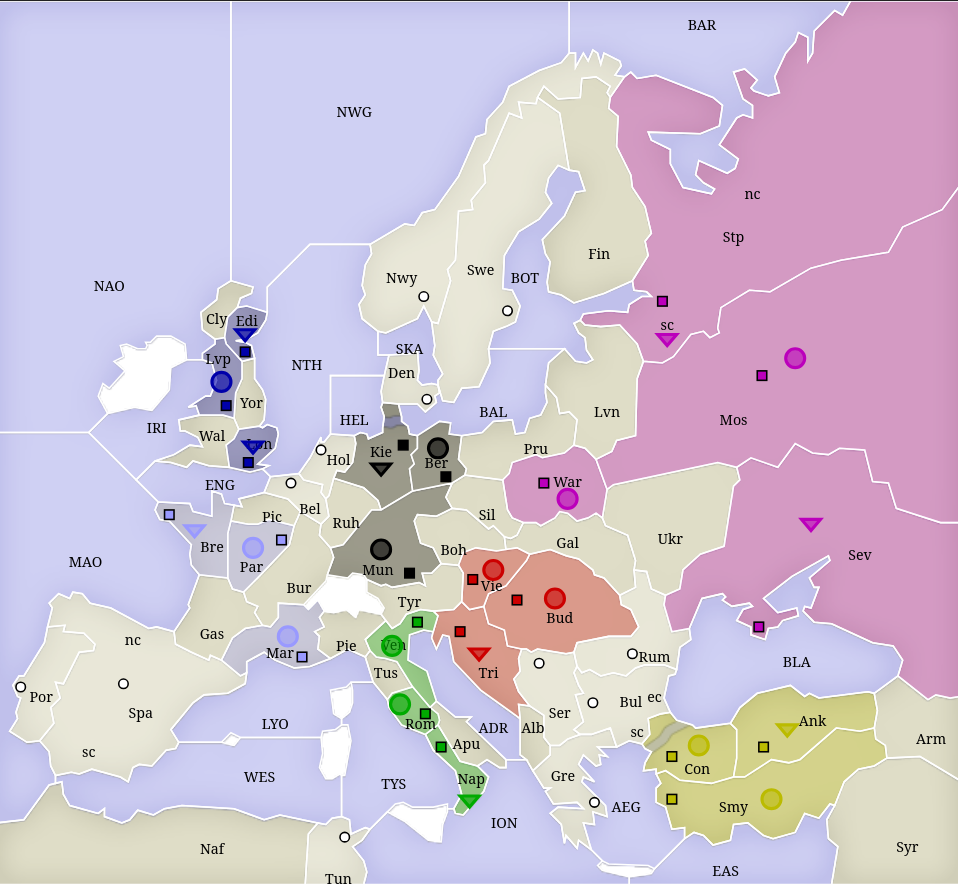
The most obvious part of Diplomacy is the map of Europe1 with the great powers at the turn of the 20th century — England (really the uk), France, Germany, Italy, Russia, and (Ottoman) Turkey. Each power starts with 3 units (except for Russia who starts with 4). These are divided into either armies or fleets, with equal strength.
Territories can only be occupied by one unit at a time, and are divided broadly into land, coastal, and sea territories. Armies can only stay on land and coastal areas, and fleets only on sea and coastal areas.
Territories with dots or squares are called “supply centres”. Each
supply centre allows you to maintain more units (more detail under
Turns). The player with 17 supply centres (half of the total 32) wins
the game immediately. Otherwise the game is a draw between the
surviving players.
There are three special territories on the map that each posses two “coasts”; Spain (Spa)2, Bulgaria (Bul), and St. Petersburg (Stp). This means that while only one unit can be inside one of these territories, a fleet can only move in or out of it depending on what coast it is located in. For example, a fleet in St. Petersburg’s north coast (Stp nc) can move to Norway (Nwy) or the Barents sea (bar), but not to Finland (Fin) or the Gulf of Bothnia (bot).
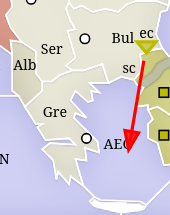
The territories of Kiel (Kie) and Constantinople (Con) act as canals, and fleets can travel freely through them even though their coasts are divided into two parts by Denmark and Bulgaria respectively. This does not mean that a fleet can pass through them (from hel to bal for example) in a single turn — they must first pass through the canal territory.
Moving around
One of the critical parts of Diplomacy is that all players make their turn at the same time — as mentioned in the introduction. This means that you can enter your orders at any time during the day, and at 6am the orders of all players are carried out (or adjudicated). You must coördinate your plans with the other players before this deadline, but you can never be sure that they will stick by their promises…
Backstabbr offers a “sandbox” feature, and I can not recommend it enough. Use it to check if your orders are valid, and what will happen if your oppenent(s) does different things. Backstabbr allows you to input incorrect orders — try moving an army from Liverpool to Syria — but illegal moves will not do anything.
How do you move pieces around on the map then? There are three (four for fleets) possible actions for each piece. They are:
Hold
Do nothing and stay in place. This is usually a bad thing to do because a piece can often be doing something more productive but it is essential when needed.
Move
Moves the piece into a territory that it borders. Keep this in mind for fleets, as the coast only borders the part of the touching the coast (for example, a fleet in Rome (Rom) does not border Venice (Ven)).
If a piece is already in a territory that you wish to move to then that piece must either leave on the same turn as you enter or be made to leave by force. This brings us to the next possible move:
Support
If a unit wishes to attack another and enter its territory, it must have help from another unit. This other unit must also border the territory being attacked, but it does not have to border the other unit attacking (aka you can only support into territories that you could also have moved to).
Each unit always has a strength of one, and contributes its strength to the unit it is supporting. If a supporting unit is attacked when it is supporting, the support is “cut”. The side with greater support wins. If the sides have equal strength nothing happens. If both sides are trying to move to the same territory this is called “bounce”, and both units stay in their old territories.
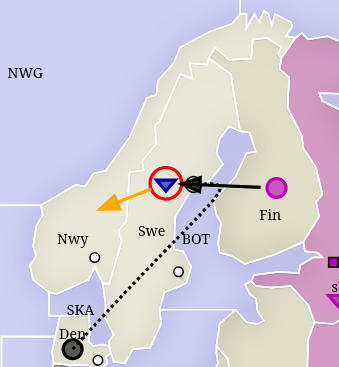
Support is done by clicking first on the unit providing support, then the unit to support, and then on the territory to attack. It is helpful to use the mnemonic X supports Y to Z (Serbia supports Greece to Bulgaria). If supporting a unit’s hold order, double-click the unit that you want to support. If you double-click a unit that then uses a move order, the support won’t do anything.
If a unit is defeated it will be forced to retreat, giving the other players a day off. It can retreat to any neighbouring territory that it could have moved to had it tried. If there are no valid options, it is destroyed.
Keep in mind that you can support other players’ units, and will likely need to do so in order to defeat your common enemies.
Convoy
This order is unique to fleets. They allow armies to traverse over sea tiles. A convoy is done by first pressing the army that you wish to move and then the location to move it to (similarly to support — X convoys Y to Z). Convoys can be chained together. They are otherwise identical to holds. Armies should be ordered to move directly to their destination.
Turns
There are three turns; spring, fall, and winter. Units can move during spring and fall turns, but they only capture supply centres at the end of the fall turn (or at the beginning of winter, depending on how you look at it). On the winter turn, each player builds more units in their starting supply centres, or deletes units, so that their total number of supply centres equals their number of units. If a supply centre is occupied during the winter new units can not be built there.
Country Strategies
To give each player a starting point into their strategies I have quickly written some recommendations for possible opening moves and general strategies. I have written this before we were given our countries, so it should hopefully not be deceitful in any way.
I highly recommend searching up some “opening moves” or strategies on the interwebs as well to get another perspective, as well as reading what your immediate neighbours are likely to do.
England
England’s primary focus should be to get a foothold on the continent proper. Its starting expansion should always include an attempt to get Norway, but it will be helped greatly if France and Germany allow it to get Belgium. Other than the two western powers it also interacts a great deal with Russia in Scandinavia, whose starting territory of St. Petersburg it will border after it obtains Norway.
Maintaining dominance of the seas is critical to avoid an invasion of Great Britain, and to project power along the many supply centres straddling the coast.
France
Arguably the strongest power, it can quite easily obtain Spain and Portugal in the first year with no one able to stop her — and can even argue for a third “build” by obtaining Belgium. France has to decide on if it should kill either Britain or Germany long-term, and since Germany can be attacked on more fronts it is often better to pick Britain. It also has a lot to do with Italy, but it can be hard to get armies around the alps or fleets around Iberia without evoking suspicion.
Turkey
The hardest country to kill, at least quickly. Can get a very strong alliance with Russia, but is at the same time doomed to be threatened by their Black sea fleet stuck at Sevastopol with no one else to attack. The classic choice is to orchestrate a “bounce” between the fleets in the first round, allowing both players to move freely without the other being able to attack year one.
Turkey’s natural year-one expansions are really only Bulgaria, but if you can bargain for it you might also be able to get Greece. It is generally hard to get troops out of Anatolia, but that also means that it is easily defensible.
Turkey, Russia, and Austria (sometimes Italy as well) all have a lot of interests in the Balkans, and controlling the Balance of power in this region will be critical.
Russia
Russia has the most units at the start of the game, but this quickly shows itself as bittersweet. Your two fleets, on almost opposite sides of the map, are largely stuck — especially the southern one — and you have the most neighbours out of all corner powers. Russia is then immediately interested in the dynamics of every place on the map, even in how Italy or France can weaken your neighbours in Austria and Britain respectively.
Its natural year-one expansions are Romania and Sweden, but gaining more than that year two quickly gets difficult. Just as for Turkey the Balkans are of prime interest, but also the game around Scandinavia together with Germany and England.
Playing Russia means trying to balance these two regions against each other, shifting units between them. If you push all your armies in one direction you are almost sure to succeed, but you leave yourself very vulnerable in the other direction.
Austria
Austria is one of the three central powers — together with Germany and Italy — who are all very exposed on all sides. Playing Austria requires not just balancing the game in the Balkans, but also making sure that you are not stabbed in the back by Germany or Italy as soon as you move out of your starting territories.
Your natural expansion is Serbia, and you can almost guarantee Greece by moving your fleet to Albania and then supporting it from Serbia with your army, although this of course leaves Trieste open to a turn one attack by Italy.
Italy
The same applies to Italy as Austria, you are very exposed to France, Austria, and Turkey from the start and remainder of the game. You only have one clear expansion to take year one — Tunis — and will then have to go into conflict with neighbours that are likely stronger than you. Remember that the pen is mightier than the sword, and your many neighbours’ enemies are equally numerous.
If you are feeling particularly ambitious you may even try to get either Austria or (more likely) Turkish support into Greece, getting involved in the profitable misadventures in the Balkans.
Germany
Germany, is the weakest part of the “western triple” (England, France, Germany) due to its simultaneous status as a central power. Its central position is however a strength at the same time as it is a weakness because it can rapidly expand across the map. A brand new army built in Munich can reach nine other supply centres within just two moves (aka in one year) — Warsaw, Vienna, Trieste, Venice, Marseilles, Paris, Belgium, Holland, and Denmark — even more if counting your starting ones of Kiel and Berlin.
Holland and Denmark are your natural expansions, but just as with France and Britain it would be very valuable to quickly obtain Belgium. But remember that gifting it to one of them may also allow you to obtain a valuable friendship. ❦
Footnotes:
There are alternative versions for other regions, but it is traditionally played in Europe.
A note on the naming and spelling of territories: Sea territories are spelled in all caps (like mao, Middle Atlantic Ocean, and bla, Black Sea), while land territories have only the starting letter capitalized. Starting supply centres are named after cities, while the others are named after countries. Other land regions are named after their more broad geographic region (Like Galicia, Burgundy, or Wales).