
Elements of Economic Security
Thus was written for Chinatalk’s Essay Contest on Economic Security,
and was originally submitted in 2026-02-24 ad (and thus before the
Iran war). The original submitted pdf can be found here.
Introduction
Back in 2024 I was part of the first class of a new course at the Swedish Defence University titled Economic Security in Competition, Conflict and War. Throughout that course it became clearer and clearer to me that the field of economic security has a central element that makes it fundamentally difficult to implement. The subject has only become more relevant as of late, with the People’s Republic of China (prc) showing no sign of stopping its entrenchment into critical sectors of the economy and with ever-strengthening winds in the sails of protectionism everywhere from Warsaw to Washington. As such it is an issue that has continuously been brewing in the back of my mind these past years. But despite increased interest in the topic it has not become any clearer what constitutes economic security, and how it should best be attained and maintained. A crude definition might be the following:
Economic security is the ability to continue ability to maintain a healthy economy through dramatic changes in macroeconomic conditions.
Notice how this definition does not explicitly mention war or international conflict. The title of my course was aptly chosen, for economic security is not just relevant in the high-stakes environment of all-out war, but is also a deciding factor in the everyday life of international competition. Ever since the second world war great powers have been largely unable (or at least strongly unwilling) to enter into direct conflict with one another, largely due to the invention of nuclear weapons. The sphere of economic warfare has therefore become a new domain of warfare, along with the technological ones of cyber and space. Where it not for nuclear weapons Europe would assuredly be in a hot war with Russia at the moment, but instead it has been able to maintain the conflict at a lower level of the escalation ladder — purely in the realm of economic warfare.
During the cold war the west and the communists were involved in an intense economic struggle; in which the west was adamant in making use of its unique strengths to prevail against the Soviet Union. The rise of the prc has put this thinking into something of a crisis. China is a large country, it is only natural for it to make up a correspondingly large share of global production, but we should not aim to copy it in an attempt to insulate ourselves from its autocratic rulers.
What does a resilient economy look like?
Much thinking in the field boils down to improving the resilience of one’s economy, so that it can better withstand shocks from outside actors or events.1 Resilience has become something of a buzzword in defence circles, akin to ai, Blockchain and Quantum in tech. What exactly it stands for is unclear and complex. For a visualisation, here is a graph I was shown as part of that aforementioned course showing what aspects of the Swedish model are beneficial and/or negative to resilience:
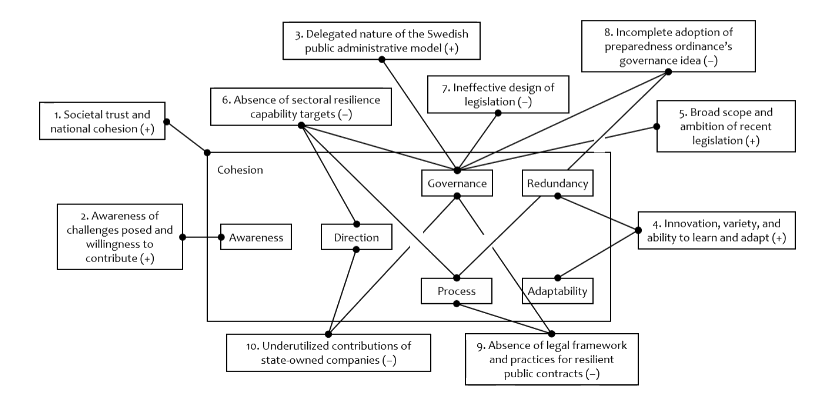
It is immediately clear that this is a somewhat muddy topic. There are quite a few different aspects to the term (as showcased above), not just in what concretely contributes to improved resilience but even to what sectors are involved in the first place. It is a solidly interdisciplinary term, one fit for a new age of political economy — albeit one that this time is principally oriented externally toward the international realm.
Economic resilience represents two qualities that are really quite different. The first aspect it stands for the ability to robustly survive the initial disturbance. In this sense it is a measure of constitution of stalwartness, and of the capacity to just keep on doing business when the situation changes. This is the primary focus of much thinking in the field of economic security. It argues for autarkic (or at least protectionist) polices that in some regards is reminiscent of the mercantilism of the 16– and 1700s. The national wealth and economic might is seen as that which is produced and processed within the state’s national borders — international trade is either seen as a necessary weakness or as a possibility for coercion. But equally important is the second meaning of resilience: adaptability and economic vigour.
The structure of the economic landscape has always been changing, and one’s economy needs to be able to keep up with those changes. To do this the economy must maintain a high level of dynamism that allows one not just to shift around production and consumption to new markets, but also the ability to utilise new technologies and to break into new sectors. Being resilient in this regard means taking a punch and then getting up to continue the struggle.2 There are three primary facilitators toward this:
- A free market economy
- An open democratic society
- A high level of economic development
A keen reader might realise that these aspects are the antithesis of ones that you want to strive for to create a resilient qua robust economy – save perhaps the last element.3 It is in this contradictory dichotomy that the difficulty in economic security lies.
The first aspect is quite quite obvious – it is hard to create a dynamic and rapidly changing economy that does not make use of the market – but it is hard to restrain the power of the state when speaking of questions of national security. This is the logic of Sullivan’s famous “Small yard with a high fence” analogy; one must allow the free market to adapt – to fail and to try again – but at the same time not allow a few critical industries to do so fully. Creating an artificial boundary of where to and not to intervene means that one gets the benefits of both of these.
Regarding the second point, an open society might in many cases be seen as a weakness, but it is in fact a strength. Autocracies (such as the prc) may in many cases be able to push through reform or industrial efforts more clearly, but they do so at hidden costs. Liberal democracy allows dissenting voices to vent their grievances and to easily highlight corruption and misallocation of resources. Autocracies must also use considerable resources for maintaining their rule, something that does have to be done when one has the consent of the governed.4
While in Běijīng I met a young man from Hángzhōu who had previously worked for many years as a security guard, and who described the job as dull and uninteresting. He did not however want these positions to be eliminated, since they had offered him a stable income when he was fresh out of school. These jobs act as a societal bribe for the maintaining of the security apparatus. The scale of this is enormous; every entrance (of which there are multiple per station) to the Běijīng metro has a security checkpoint staffed by 3-5 guards.5 Pinghan Liang (梁平汉), a professor at Sun Yat-sen University’s School of Government has estimated the direct cost of these security checks to be 1.8 billion usd, employing 224 thousand people.
The third point is closely related to the first, but it is still different enough to warrant its separate investigation. Having a larger economy is strictly beneficial to economic security because producing more goods and services means having a bigger influence and more power to use when interacting with the outside world. The Democratic People’s Republic of Korea is perhaps one of the most autarkic (and therefore economically secure) economies in the world, but even it is reliant on trade, particularly with the prc and the Russian Federation, and due to its small size it would likely not be a threat to the security of any other state (not even to the Republic of Korea, rok) had it not possessed nuclear weapons.
Following the orthodox theory of economic security to its extreme one would end up at the division of society into small, entirely self-sufficient groups of subsistence farmers who do not rely on on the producers of any other state. But such a society would at the same time be extremely insecure, at risk of being conquered by industrialised nations like those of Europe during the Great Divergence.
While this form of resilience is incredibly strong against disruptions in trade, it is equally weak against disruptions in production. We no longer see the kinds of famines like those of the Hungry Forties6 or of the Year Without a Summer thanks to systems of food production, storage, and transport that have been made possible thanks to the modern globalised industrial economy. There have been no major famines in the Indian subcontinent for over half a century, and they largely ended as a structural problem over 100 years ago. This is not due to techniques of protectionism, but due to the adaptability of a free market, and of the increase in technology that such a increase allows for.7 The productivity of industrial society is a tremendous power to wield, and one should care for it as much as they can.
The long term objective for any state is then to augment its power by increasing the productive powers under its command or, in other words, to increase gross domestic product (gdp), and any coherent economic security objective should incorporate such a goal and the methods to accomplish it (such as investments in r&d, a sensible tax policy, and the construction of basic infrastructure). That this is the long term objective is significant, for it may be easily clouded by short term thinking.
The Argentine Republic was once one of the the most prosperous and wealthy countries on earth, for a short time in the 1890s even surpassing the United States of America and the United Kingdom in gdp per capita. The reasons for its downfall are of course numerous, but of interest to us are the goals set by Peronism of economic independence. The technique of import substitution we now know have failed many times, and creates an insular industry unable to compete internationally. In the short term however, such techniques protects jobs and the wealth of investors who have already “bought in”. Following a system of “whack-a-mole” it allows one to (comparatively) easily eliminate dependencies on other nations. But doing this completely is impossible, as the impacts of the 1930s depression on Argentina shows. Instead what must be done is to focus on the fundamental capabilities of the economy.
Building a resilient economy
The enormously successfully policies of the east-Asian tigers takes this advice. Instead of acting in a reactive sense — where one merely responds to what happens around the world — these countries (The rok, The Republic of China (roc), Singapore, and Hong Kong) adopted Export-oriented industrialisation (eoi) in niche sectors where they possessed a comparative advantage. This does not meaningfully reduce dependency on the outside world, but instead puts the ball in your own court by creating dependencies on your own country. The construction of a Texas Instrument plant in 1968–’69 on Formosa was one way to explicitly link the roc with the rest of the world (and with the us in particular) long before Taipei achieved its legendary dominance over the ic industry that is so admired today.
But the roc is incredibly dependent on the rest of the world — it is a small island almost entirely reliant on sea-bound imports for energy and food, as well as to the broader lifeline of general goods and commodities needed to sustain its economy. None of the tigers tried to obtain leverage through de-risking, they all made themselves indispensable through investments in forward-thinking industries such as financial services (in the case of Hong Kong and Singapore), electronics (all four in some regards), and automotive (Korea).
A modern example of what not to do might be found in Merz’s Germany. The reversal of the decision to in the near-future forbid the sale of combustion engine cars is, irrespective of any environmental concerns, a decision to lock oneself into the economy of the past. Germany did not obtain a car industry by focusing on its large coal and steel steel industry, it did so by seeing a chance to further specialise and make use of its highly skilled and educated population. The construction of combustion engine cars is a dying industry, if it is not dead already — at least in its future prospects. The decision was taken to protect modern industrial workers, but ideally this group could be let free from their duties as the band of the titanic, and instead use their knowledge and expertise to work in the forward-looking industries of tomorrow such as drone manufacturing, artificial intelligence, nanotechnology, chip manufacturing, renewable and low-carbon energy, and electric vehicles. Doing this would give Germany the initiative tomorrow at the cost of pain today, instead of erroneously hoping that combustion engine cars will ever be the backbone of the economy that they once were.
America, as the only major power who did not materially suffer from the war, in many regards got a head start on the later half of the 20th century — in some way the reverse of a “lost decade”. But that it has continued its economic dominance for so long, only to be rivalled by the prc after the great financial crisis (and perhaps only equalled in a few sectors after the covid-pandemic) has not been a mere gift from Fortūna. The United States (us) has made a considerable number of enormous bets, many of which have paid off over time. An examination of all of the factors that have led the us to success is of course not something that can be covered in as short a text as here, and therefore I will not endeavour to do so. But beyond all other aspects it is surely the all-mighty dollar that has cemented us supremacy over the world. It allows the us to obtain goods and services for practically free, simply in exchange for pieces of paper that the rest of the worlds needs to trade amongst themselves. Protecting this asset should be of utmost importance for any American administration that cares about the prospects for us hegemony.8
What American (and European in regards to China) strategy is much more focused on today seems to be solving the Chinese communist monopoly over rare earth minerals. This is a mistake on multiple levels. First of all, building rare earth mines will not stop the dependency itself. The prc has a three-level that includes raw materials extraction, refining, and manufacturing itself. It is of no use to go to the great effort of prospecting for mines and investing the large amounts of resources needed to create a competitive industry if one merely needs small amounts and will likely export the ore to the People’s Republic regardless. Focusing on the refining of minerals is much more efficient, particularly as the west still possesses large chemical and refining companies along with their expertise. Any action on the side of the Chinese would then carry a proportional economic pain; The export of rare earth metals is a negligible part of China’s total exports and so implementing export controls comparatively cheap. If the west possessed significant refining capacity a stop in ore exports would lead to disruptions in the prc’s manufacturing base, leading to internal pressure to back down.
But worse than an imperfect strategy is the focus itself. Ed Luttwak pointed out quite concretely in an interview with Chinatalk that when the United Kingdom first successfully bombed Hamburg
… the Royal Air Force tells Churchill, “We can win this war. We’ll just stand down the useless army and navy. We’ll bomb Hamburg.” Churchill was smart enough to say, “No, because your very success of last night condemns you to failure.”
War, and all strategy, is a form of dialectic whereby one acts and the other reacts. As in a game of Go you might have thought out a perfect plan to defeat your opponent in a given area of the board, only for them to place a piece on an entirely different region. You do not get to place all of your pieces at once and then bask in the sunshine of victory — the enemy will counteract you at every step of the way and drag you into the mud of the dialectical process. It is a common mistake to merely think about your own actions; as Harris put it “The Nazis entered this war under the rather childish delusion that they were going to bomb everyone else, and nobody was going to bomb them”. The same idea is present in economic warfare in that an improvement in military technology or methodology carries within itself its own counter-reaction — one therefore needs to continuously invent new such techniques.
The weapon of rare earths became worthless once it was universally unleashed, just as the oil weapon became after 1973. It may still be useful for some time going forward, but new deposits and technologies will in the long run win out. Stockpiles will increase and (in the worst case) smuggling routes will grow.9 One must take this opportunity to look forward toward the dependencies and industries of tomorrow instead of continuing to focus on the moves that have previously been played — for the deciding pieces are already being put in motion.
As for how to measure this dependency it is worth mentioning that the simple Herfindahl–Hirschman index10, mostly used to determine market concentration for antitrust purposes, actually has its origins in the primordial times of economic warfare. It originates in Hirschman’s work National Power and the Structure of Foreign Trade originally published in 1945.11 As is clear from careful examination of the equation (and as gracefully pointed out by The Economist) the score rapidly changes at high concentrations. This poses both risk and opportunity — decoupling does not require full substitution, it only needs to slightly reduce the major supplier’s influence; and drastically increasing market power can be done from relatively small gains.
Conclusion
It is a of course a shame that the field of economic warfare and security is seeing a renaissance not seen since the days of the Trade Clearing House during the first world war. This makes the matter all the more important; how we act now may in many ways decide the course of the rest of the century and of the global balance of power.
While orthodox theory on economic security stresses the focus on neomercantilist methods it is being increasingly clear that merely doing so is an overcorrection. Instead one must balance the tightrope that harnesses the benefits of global interconnectedness while avoiding serious dependencies on adversaries in critical industries.
This balance means that economic growth should be strategic and structured in a relative-gains manner, where one tries to choke out rival powers by constructing networks of free trade and rapid development that exclude bad actors. Growth remains important because it gives you more tools to use. We must accept that it is not possible to correctly predict the future — “But about that day or hour no one knows” — and so we must thus prepare for every eventuality. The only way to do this is the increase in the total number and value of the goods and services produced. ❦
Footnotes:
Keep in mind that these events may not be directly intending to harm you specifically. They may instead be things like natural disasters, wars between other countries (for example in the Middle East), tariff increases, industrial depressions, global pandemics, or any other major disruption in the global economy.
For a cultural reference, see Rocky’s (or alternatively Randy Marsh’s) “I didn’t hear no bell”.
But it should be noted that obtaining this last aspect might still require the techniques from the second form of resilience as we shall soon examine.
One could say that things like pensions and healthcare are payments of this sort, but they are better since they have benefits that an autocracy would also want to provide to its citizens.
The same is true for other cities such as a Nánjīng, although Běijīng seems to have more staff per checkpoint than any other city.
The reduction of a nation’s population by over a third under a 10-year period (like what happened in Ireland) would be an unprecedented disaster in economic security for any modern western economy, worse in many regards than the complete subjugation of a state’s territory.
Adam Smith’s greatest contribution is not in describing “the invisible hand”, but in how the increased division of labour is made possible only by the increased size of the market to which one is able to sell to.
The nature of American exceptionalism is partly due to the centrality of the dollar, but it is also a simple consequence of the centrality of the us economy and of American multinationals. American stocks made up 65% of the value of all stocks globally in March of 2025, but they also made up 55% of global high technology profits. It should also be mentioned that the Chinese renminbi is not a rival to the dollar, and will never be for as long as the prc runs a positive trade balance.
A few years ago a study made by the Swedish Defence Research Agency called Rare metals and great power rivalry pointed out that, despite its otherwise alarmist and hawkish tone (translation mine):
Rare metals are likely considerably easier to smuggle than more bulky goods or metals such as copper. Rare metals are also especially demanded by many states since they are decisive for economic growth and military capabilities. Therefore all conditions are in place to foster a growing illegal trade in rare metals [to complement] state corruption.
\[ hhi = \sum^N_{i=1} (S_i)^2 \]
Where N is the number of firms and S is their percentage of market share. Results closer to 1 mean a more concentrated market.
The Herfindahl-part of “Herfindahl–Hirschman” comes from Herfindahl’s Concentration In The Steel Industry from 1950, albeit without the square root.